
By KEVIN OKLOBZIJA
He once broadcast high school football games from a platform affixed to a light pole, suspended a dozen or so feet above the ground.
There were no stairs, just rungs sticking out of the pole.
That was how Don Stevens was welcomed into the glamorous world of small-market radio in Nebraska in 1969.
Not long after, he called a playoff football game on a North Dakota prairie from the top of a school bus. A card table, teetering on the rounded sheet metal of the bus roof, served as his press box. Considering the wind chill was minus-60 Fahrenheit, that light pole back in Nebraska seemed like paradise.
Yet Stevens was undeterred. He had found that calling games was his calling. Regardless of where he sat, stood or crouched.
For nearly six decades, it has remained his passion, too. A 2011 inductee into the Amerks Hall of Fame, Stevens has used his distinct, voice-for-the-ages to chronicle for radio and TV audiences more than 5,000 sporting events.
Every shot on goal, every snap from scrimmage, every bases-clearing double, every drive down the lane, every header off a corner kick, every cross-court backhand to the baseline.
For the past 40 years, Stevens has been the voice of the Rochester Americans. He’s the longest-tenured broadcaster in the American Hockey League’s 90-year history yet he approaches every game as though it’s his first.
“Seeing him love what he does after over 40 or 50 years doing it is just super inspiring,” Amerks goalie Devon Levi said. “He’s an unbelievable dude and we’re lucky to have him around.”
He’s been around it seems like forever. Stevens has described the Amerks action on the ice from 19 states and eight Canadian provinces, as well as two visits to Davos, Switzerland, for the Spengler Cup international tournament. The unprecedented run includes nearly 3,400 games, seven trips to the Calder Cup finals, two Calder Cup championships and the breaking of the franchise’s all-time scoring record by AHL icon Jody Gage.
And on every broadcast, listeners have always known who Stevens is cheering for. He has unabashedly been what some would call a homer, but in a good way. When the opponent scores, fans feel the anguish. Conversely, they sense the jubilation when the Amerks score.
It was that way on Oct. 10, 1986, when Stevens was in Baltimore Arena to call his first Amerks game. It will be that way today when, from the Giant Center in Hershey, Pa., he calls his last.
Stevens, a true legend in his profession, is retiring. Today will be his final regular season game. He’ll call the playoffs as well, if there are playoffs; the Amerks must earn a point today or they won’t qualify for the postseason. Either way, his final sign-off isn’t far away.
“Rochester holds a special place in the American Hockey League’s heart and Don has been the soundtrack of this franchise,” AHL President Scott Howson said.
He’s going out on his own terms, too. At 77, the bus rides seem longer, the climb up steps to the press box seem higher and the action on the ice perhaps seems a little faster. He wasn’t going to overstay his welcome or risk tarnishing a legacy of greatness.
Not that there was any way to do that.
“He’s the play-by-play voice extraordinaire,” said John Bednarski, who for 20 years served alongside Stevens as the analyst on Amerks broadcasts.
The funny thing is, Stevens never considered radio for a profession. He found broadcasting quite by accident. Well, actually his mother, Doris Inkin, found it for him after he realized no college was offering a degree in the card game Hearts.
And since his parents weren’t going to pay for him to flunk out of college, his mother did some quick research into what it would take to become a broadcaster. After all, she knew her son liked to talk.
Soon he was enrolled at Brown Institute in Minneapolis, and upon graduation he landed a job as the sports director and disc jockey at KRGI in Grand Island, Nebraska. He also was the assistant news director. And community service director. And the high school sports broadcaster.
Small-market radio is stingy with money, but not titles.
Over the next 15 years, Stevens relocated 11 times – always in the Midwest or West – as he climbed the ladder of his profession. Which is why, when former Amerks general manager George Bergantz in the summer of 1986 asked him to move east to become their broadcaster, Stevens told his family they’d be in Rochester no more than two years.
He figured by then, an NHL team would come calling. Two years, however, became two decades, and now it has become four. Other than a sporadic fill-in game with the parent Buffalo Sabres, Stevens never had got the call to The Show.
And he’s OK with that.
“I’m blessed, I really am,” he said. “Certainly, it’s disappointing that I didn’t make that next step. But someone, somewhere, was looking over me because this is where I should be and this is what I should be doing.”
He had come to realize that over time as Rochester became his home. But the bond was reinforced as this season has neared the end. The Buffalo Sabres held Don Stevens night on March 31, and the ovation from fans brought tears to his eyes.
The Amerks honored him four nights later, even commissioning his own bobblehead.
“Unfortunately, the likeness is spot on,” Stevens deadpanned. “That’s actually what I look like.”
That little figurine also a testament to his stature in the game. He may be calling minor league hockey, but there’s nothing minor about his talents, which is why the Hockey Hall of Fame in Toronto has put his bobblehead on display in the Buffalo Sabres section.
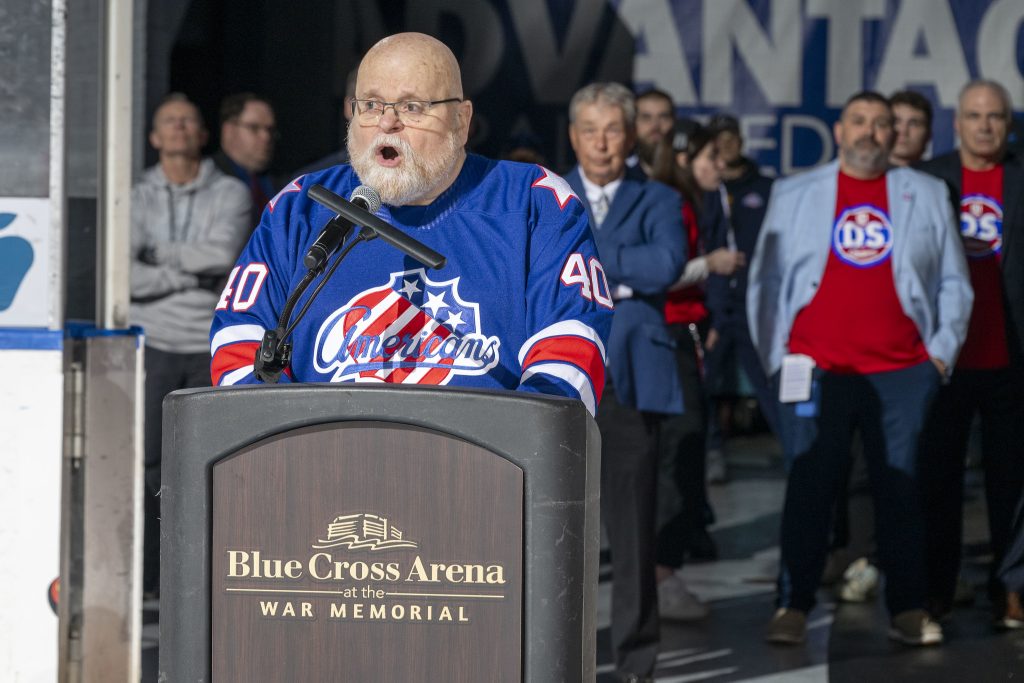
On Friday, Monroe County Executive Adam Bello declared April 17, 2026, as Don Stevens Day in Monroe County, presenting him with a plaque in a ceremony at Blue Cross Arena at the War Memorial.
“Having done this for 40 years and called over 3,000 games, he’s become part of the fabric of this community,” Bello said. “Generations of families have listened to that voice.”
During that same ceremony, Rochester Mayor Malik Evans presented Stevens with a key to the city. It’s the highest honor the city bestows on an individual.
“Forty years ago, my family arrived here, not knowing if we’d be accepted,” a tearful Stevens said. “Now I have the key.”
He also has the admiration and respect of an entire community.
“He’s the voice of Rochester,” Evans said. “He has helped create memories of the Amerks with that powerful voice.”
The accolades have caught him by surprise, and he has teared up over and over these past few weeks.
“I keep thinking it’s not going to get any better but it does,” Stevens said. “No one person deserves all this.”
Amerkland would disagree.
“He’s one of the great Amerks of all time,” said Chad Buck, vice president of business operations for the team. “We’ve dubbed Jody Gage Mr. Amerk; you could argue Don is Mr. Amerk II.
“This organization is immensely proud of him. He’ll be missed behind the mic, but he’ll always be an Amerk.”
From Stevens’ four decades with the Amerks:
A gaggle of goalie goals
Stevens called the first four goals credited to goalies in the AHL, including the first, by Amerk Darcy Wakaluk, who actually shot the puck from his end into an empty net at the other in Utica in December of 1987.
“I guess they just like the way I say, ‘He scores,’ ” Stevens joked years ago.
Now pinch-hitting for Don Stevens, Milton Berle
When Stevens was the voice of Triple-A baseball’s Phoenix Giants in 1982, it wasn’t unusual for celebrities to drop by the baseball press box.
One night, comedian Milton Berle joined him for a few innings and Stevens let him do a little play-by-play.
“The first pitch he called he said, ‘Low and outside; Berle one.’ ”
Now pinch-hitting for Don Stevens, Dave Baseggio
When the Amerks played in Glens Falls against the Adirondack Red Wings on Nov. 23, 1991, Stevens’ voice failed him during the afternoon.
Knowing he couldn’t call the game, he asked the only other person from the team on the trip, defenseman Dave Baseggio, if he could take the reins. Baseggio wasn’t going to be in the lineup that night.
Baseggio called the first period before Stevens voice allowed him to take over for the second period.
Some names are difficult to pronounce
In a rare instance where loyalty to team won out over professional standards, Stevens made it clear what he thought of the work of referee Harry Dumas during a Jan. 5, 2003, game at Houston.
After perhaps the sixth – of what would be 11 – power plays awarded by Dumas to the Aeros during the Sunday matinee, Stevens pretended to have difficulty pronouncing the referee’s name.
Perhaps three or four times over the next period and a half, each time the Amerks were penalized, Stevens would say, “and that penalty was called by today’s referee, Harry Dumb-ass, at least I think that’s how it’s pronounced.’ ”
The Don Stevens professional timeline
1969 – Grand Island, Nebraska, as a disc jockey and sports director
1973 – Denver in those same roles
1975-76 – Sioux City, Iowa, as broadcaster for USHL minor pro Musketeers
1976-77 – Grand Forks, N.D., for University of North Dakota hockey as well as high school sports
1979-80 – San Diego for the Pacific Coast League hockey Mariners and the San Diego Friars of World Team Tennis
1980-81 – Seattle for the major junior Breakers in the WHL
1981-82 – Portland, Oregon, for the WHL’s Winter Hawks
1982 – Phoenix for Triple-A baseball
1982-83 – Back to Seattle for Breakers hockey
1984-1986 – Salt Lake City for the IHL’s Golden Eagles
1986 – Rochester
2026 – One final sign-off.

Simply a great piece Kevin. You captured the very essence of the man behind the mic. I only wish the team had as much energy and fire this year as Donnie has.
This article is a keeper. And it will be sad when Donnie signs off for the last time this afternoon.
Great article. That’s why your in the Amerk
Hall of Fame too.
Nice story, Kevin! Up to your usual high standard and a tribute to a trult great announcer!
I had the honor of working with Don when I was a PA Announcer for the Amerks. A pro’s pro and deservedly recognized as a Hall of Famer. NHL teams missed out on hiring him for “The Show”. But their loss was Rochester’s SCORE with keeping Don in his adopted home! Thanks Don, enjoy retirement sir.
Kevin–just tossing this random thought out there: I was so impressed watching the road games where Donnie was making his final appearance, and the tributes each team gave him recognizing what an asset he has been not only to the Amerks, but to the league. Wouldn’t it be nice if someone could collect all those video tributes and compile them into a tribute video that could be shared with many longtime fans of Don, who never got the chance to see those tributes. they showed the class that still exists in the AHL despite the wailings of a very loud minority that still try and tell us the league is meaningless, the teams don’t matter and nobody cares.
anyway, wouldn’t such a ‘highlight reel’ like that be something. I know it would embarrass Don, but it would be so meaningful for the fans, especially since this 70th anniversary year surely did not go the way most of us hoped on many levels. What do you think?